
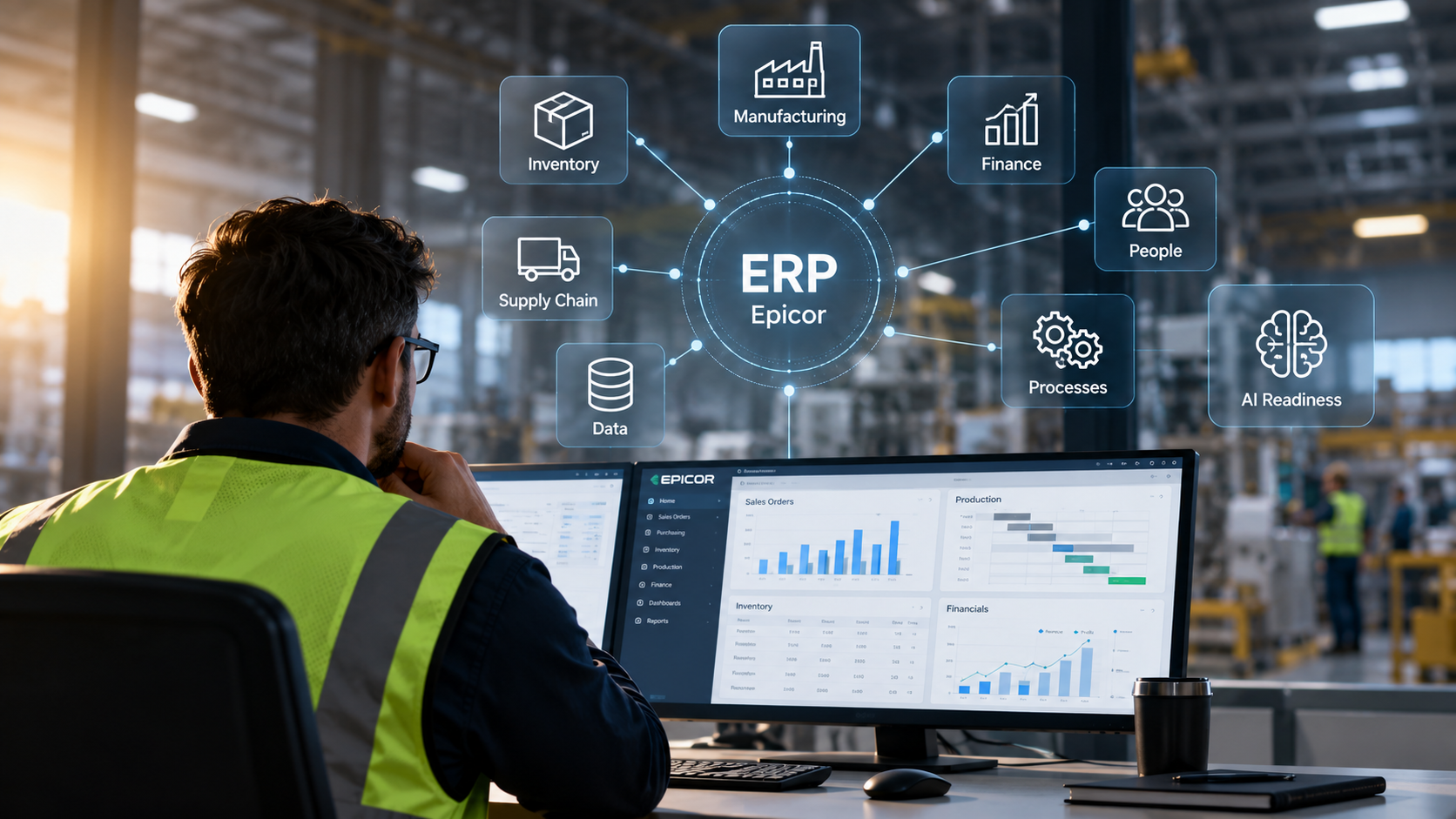
Every organization develops knowledge as it operates. Employees solve problems, identify better processes, adapt to changing conditions, and learn from experience. Over time, that accumulated knowledge can become one of a business’s most valuable assets. But only if the organization can capture it, share it, and build on it instead of letting it remain isolated.
In a recent Epicor article, “The Power of Shared Knowledge,” Epicor explores how organizational knowledge can either compound over time or remain trapped with individual employees and teams. When businesses don’t document, standardize, or make lessons accessible across the organization, they often end up solving the same problems repeatedly instead of building on what they have already learned.
For manufacturers and distributors, that challenge extends well beyond training or knowledge management. It directly affects how processes are standardized, how information moves across departments, how effectively an ERP system is used, and ultimately how prepared the business is to adopt artificial intelligence.
At Stratify Holdings, we believe building an AI-ready ERP environment begins with that same principle. Organizational knowledge needs to become structured, accessible, connected, and usable across the systems and processes that drive the business.
Why Tribal Knowledge Creates Challenges for an ERP
Every manufacturing or distribution organization has some degree of tribal knowledge. One employee may understand why a particular production schedule is structured a certain way, while another knows how a complex customer account needs to be handled.
A warehouse manager may know the workaround for a recurring inventory issue, and a purchasing employee may know from experience which supplier is likely to create delays. The business may technically possess all of this knowledge, but that information is often dependent on the people who carry it rather than being embedded into repeatable systems and processes.
That creates real operational risk. When experienced employees leave, change roles, or become unavailable, organizations can lose valuable institutional knowledge. New employees may take longer to become productive, processes can vary across departments or locations, and recurring problems may have to be solved repeatedly.
This also limits the value companies can get from their technology. An AI-ready ERP environment depends on clearly defined business processes, dependable data structures, documented operational rules, and accessible information. If critical knowledge exists only in someone’s head or within disconnected spreadsheets, notes, and inboxes, both ERP and AI systems have less reliable information to work with.
ERP Implementation Creates the Foundation for AI Readiness
A successful ERP implementation should do more than migrate transactions from one software platform to another. It should create an opportunity to examine how the business operates, identify where processes break down, and determine which workflows should be standardized, connected, or improved.
That means examining how orders move through the organization, where employees are re-entering information, which decisions still depend on spreadsheets or individual experience, where approvals create delays, and which recurring activities could be automated.
This is why Stratify Holdings approaches ERP implementation as an operational transformation initiative rather than simply a software installation.
For manufacturers using Epicor Kinetic, that can mean aligning production, scheduling, inventory, supply chain, quality, finance, and reporting within a more connected environment.
For distributors using Epicor Prophet 21, it can mean improving the way purchasing, inventory management, warehouse operations, order management, pricing, customer service, and financial processes work together.
Our work goes beyond system configuration. A strong implementation requires business process review, solution design, data migration, integrations, testing, training, governance, and continuous optimization. The objective is to build an ERP environment around how the business needs to operate rather than simply recreating legacy processes inside a new platform.
Shared Knowledge Strengthens an ERP Environment
One of the central ideas in Epicor’s discussion of shared knowledge is that individual learning only becomes organizational learning when lessons can be captured, accessed, repeated, and improved upon.
Employees may solve problems every day, but an organization becomes more capable when those solutions can be translated into processes, systems, and shared knowledge that other employees can use.
ERP provides an important part of that infrastructure because it can help transform operational knowledge into structured data and repeatable workflows. Instead of relying on one employee to remember when inventory should be reordered, planning rules can support more consistent replenishment decisions.
Instead of manually assembling production information from several spreadsheets, an ERP platform can centralize information related to jobs, materials, capacity, scheduling, inventory, and financial performance. Rather than depending on informal knowledge to understand an approval process, workflows can establish consistent responsibilities, permissions, and escalation paths.
The result is a gradual shift away from dependence on individual memory and toward institutional capability. The business becomes more consistent, measurable, and better able to retain what it has learned over time.
That is an important operational improvement on its own, but it also creates exactly the type of structured environment needed for an AI-ready ERP strategy.
AI-Ready ERP Starts With Connected, Reliable Data
Businesses are increasingly exploring artificial intelligence for forecasting, automation, analytics, customer service, knowledge retrieval, decision support, and operational productivity. However, AI is only as useful as the environment around it. An organization with fragmented applications, duplicate records, inconsistent processes, poor data quality, undocumented workflows, and isolated knowledge will struggle to get reliable value from AI regardless of how advanced the technology itself may be.
The challenge in these situations is often not the AI model itself. It is the operational foundation underneath it. AI systems need reliable data and meaningful business context to generate useful outputs. If the same product, customer, job, supplier, or inventory item is represented differently across multiple systems, even sophisticated AI can inherit those inconsistencies.
An AI-ready ERP strategy therefore depends on connected data, standardized processes, reliable data quality, clearly defined business logic, effective integrations, and organizational adoption. These have always been important ERP implementation priorities, but they become even more important as organizations begin using AI to automate tasks and support operational decisions.
Building an AI-Ready ERP With Epicor Kinetic
For manufacturers, Epicor Kinetic can provide a centralized environment for managing many of the processes that generate and depend on operational knowledge. Production activity, inventory, scheduling, quality, supply chain information, financial data, and other operational processes can be connected within a common framework, giving employees and leadership greater visibility into what is happening throughout the organization.
The software alone, however, does not automatically create an AI-ready ERP environment. The value depends heavily on how Epicor Kinetic is implemented, configured, integrated, and adopted. Stratify Holdings works with manufacturers to align Epicor Kinetic with actual operational requirements through process discovery, system configuration, data preparation, reporting, integrations, user training, and continuous improvement.
The goal is not simply to create a functioning ERP instance. It is to establish an operational environment where accurate information can move throughout the business and support better decisions. Once that foundation is established, manufacturers are in a stronger position to introduce advanced analytics, automation, and AI capabilities because those technologies have better access to consistent operational data and context.
Building an AI-Ready ERP With Epicor Prophet 21
The same principle applies to distribution. Distributors operate in environments where relatively small improvements in inventory visibility, purchasing, pricing, order management, warehouse efficiency, and customer service can have a significant impact on margins and overall performance. When those processes depend heavily on disconnected applications, manual workarounds, spreadsheets, or tribal knowledge, scaling becomes more difficult and operational consistency can suffer.
Epicor Prophet 21 provides distributors with an industry-focused ERP platform designed to connect many of those core activities. Stratify Holdings helps organizations implement and optimize Prophet 21 around their specific operational requirements while also addressing the data, integrations, reporting, and workflows surrounding the platform.
Creating an AI-ready ERP environment for distribution means going beyond simply centralizing information. The objective is to turn operational knowledge into repeatable processes that can be measured, optimized, and eventually augmented through automation and artificial intelligence. A more connected Prophet 21 environment can therefore support both immediate operational improvement and longer-term AI initiatives.
From ERP System of Record to AI-Ready ERP Foundation
ERP systems have historically been viewed primarily as systems of record. That role remains essential because businesses still need reliable systems for transactions, inventory, production, customers, suppliers, and financial information. What is changing is the strategic importance of that information and the role ERP plays in connecting the broader technology environment.
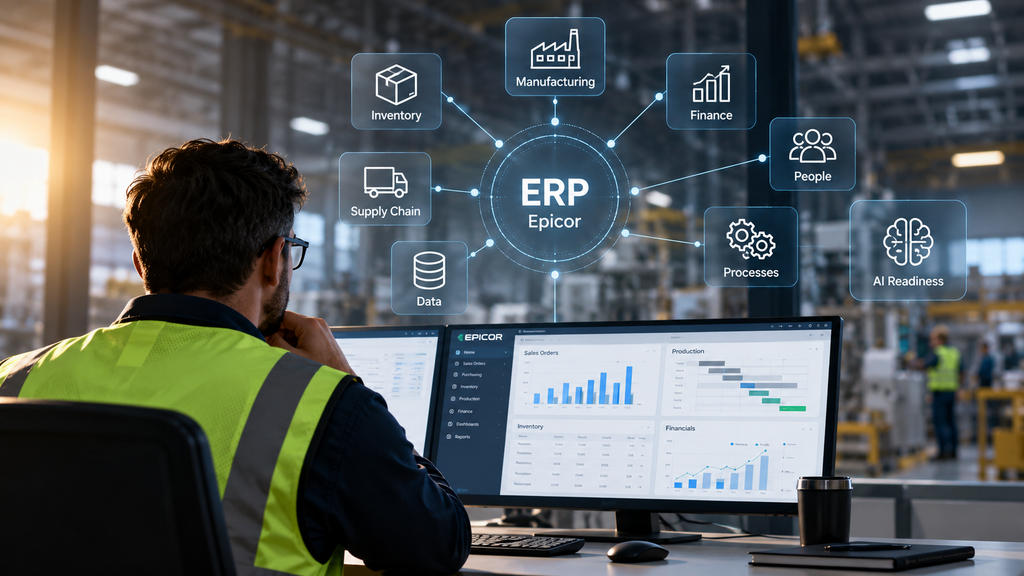
When implemented effectively, ERP can become the operational foundation that connects people, processes, data, and applications across the organization. That foundation matters because modern AI does not operate independently from the business. It needs context, dependable data, clearly defined processes, and access to institutional knowledge that explains how the organization actually functions.
This is where the concept of AI-ready ERP becomes increasingly important. The more effectively businesses capture their operational knowledge within connected systems, the more useful future automation and AI initiatives can become. In that sense, ERP modernization is increasingly becoming a prerequisite for broader digital transformation rather than an isolated technology project.
Using AI-Ready ERP to Turn Knowledge Into an Operational Advantage
Epicor’s broader argument is that organizational knowledge becomes more valuable when businesses create the conditions to capture and share what their employees learn. Strong organizations do not simply solve problems once. They retain lessons, establish better ways of working, make knowledge accessible, and continue improving from where previous improvements ended.
ERP implementation can play an important role in making that possible. By connecting operational data, standardizing processes, integrating systems, improving reporting, and reducing reliance on disconnected workflows, organizations can begin turning individual experience into broader organizational capability.
That capability becomes especially important as businesses prepare for AI. Artificial intelligence can help organizations analyze larger volumes of information, automate repetitive tasks, identify patterns, improve forecasting, and support decision-making. However, it still depends on the quality and structure of the underlying environment. Businesses that have already organized their data, clarified their processes, and connected their systems are generally better positioned to pursue those opportunities.
Build an AI-Ready ERP Strategy With Stratify Holdings
Artificial intelligence may represent the next major phase of enterprise technology, but organizations do not become AI-ready simply by purchasing an AI platform. They become AI-ready by building the operational environment those technologies need to perform effectively.
Stratify Holdings helps manufacturers and distributors create that foundation through business process optimization, Epicor ERP implementation, systems integration, data strategy, AI readiness, and technology-enabled operational improvement.
Whether your organization is replacing a legacy ERP, optimizing an existing Epicor Kinetic or Prophet 21 environment, preparing its data and processes for artificial intelligence, or pursuing a broader digital transformation initiative, the same principle applies: the more advanced the technology becomes, the more important the operational foundation underneath it becomes.
Building an AI-ready ERP environment allows organizations to connect more than software. It connects institutional knowledge, data, processes, people, and technology into an operational foundation that can continue improving as new capabilities emerge.
If your organization is evaluating its ERP strategy or preparing for AI adoption, Stratify Holdings can help assess your current environment, identify operational gaps, and develop a roadmap for what comes next.
Contact Stratify Holdings to discuss your ERP environment and AI readiness strategy.
Schedule a Free ERP Assessment: www.stratifyholdings.com/contact-us/
