

Private equity firms are under constant pressure to create measurable value across their portfolio companies. Whether the business manufactures products, moves inventory, or sells directly to customers, the goal is rarely just growth for growth’s sake. The real objective is disciplined growth that improves visibility, margin performance, cash flow, operational consistency, and long-term enterprise value. That is why the PE portfolio ERP strategy process has become such an important conversation for private equity firms and operating partners. A portfolio company can have strong leadership, solid demand, and a clear market opportunity, but if its systems are disconnected, outdated, or too generic for the industry, growth becomes harder to manage.
In a recent Epicor blog, the company explains that private equity firms need a repeatable technology foundation that can help improve EBITDA growth, cash flow, risk reduction, and hold-period performance across multiple companies. Epicor frames this through the “Make, Move, Sell” portfolio model, covering manufacturers, distributors, and retailers that need industry-specific systems built around real operational workflows.
At Stratify Holdings, we see this same challenge across the businesses we support. ERP is not just a software decision. It is a value-creation decision.
Why PE Portfolio ERP Strategy Matters
Private equity firms often acquire companies with different systems, processes, reporting structures, and levels of operational maturity. One business may be using spreadsheets to manage inventory. Another may have an ERP system but lack clean reporting. Another may have strong sales growth but weak visibility into margins, purchasing, or fulfillment.
These gaps create friction.
For PE-backed businesses, that friction can affect:
- 100-day planning
- Margin improvement
- Cash conversion
- Inventory visibility
- Order accuracy
- Financial reporting
- Integration after acquisitions
- Exit readiness
Epicor notes that operating partners need to move beyond disconnected point solutions and build repeatable playbooks that create measurable results across portfolio companies. The same blog highlights key value-creation levers such as revenue growth, margin expansion, working capital efficiency, SG&A optimization, and risk reduction.
That is exactly where a stronger ERP strategy can make a difference.
A well-planned ERP environment gives leadership teams a clearer view of what is happening inside the business. It connects finance, inventory, purchasing, production, sales, customer service, and operations into one more reliable system of record. For PE firms, this can turn ERP from a back-office tool into a portfolio-wide operating advantage.
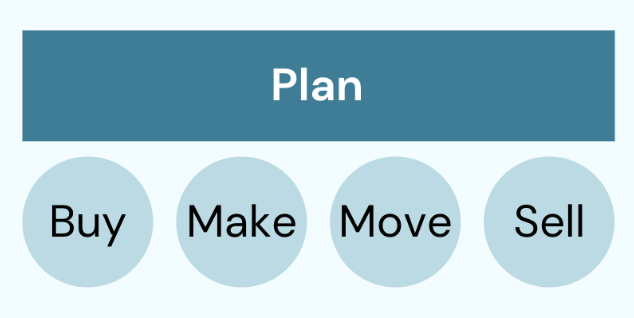
The Make, Move, Sell Model
Epicor’s “Make, Move, Sell” framing is useful because it reflects how many industrial and commercial businesses actually operate.
Some companies make products. These businesses need better production visibility, scheduling, materials management, quality control, and shop-floor coordination.
Some companies move products. These distributors need stronger inventory control, warehouse visibility, pricing discipline, supplier coordination, and order fulfillment.
Some companies sell products. These retail and resale businesses need connected point-of-sale, customer management, inventory accuracy, purchasing, and reporting.
Many portfolio companies do more than one of these things. A manufacturer may also distribute. A distributor may support e-commerce or retail channels. A retailer may manage complex purchasing, replenishment, and multi-location inventory.
That complexity is why generic software can fall short.
Epicor emphasizes that its solutions are purpose-built for manufacturers, distributors, and retailers, with a cloud-native and modular architecture that supports phased rollouts across multiple entities. The blog also points to tools such as CPQ, digital commerce, MES, APS, inventory planning, EDI, ECM, automation, cloud ERP, governance templates, and analytics as part of a broader portfolio operating system.
For Stratify Holdings, this aligns with a practical belief: ERP should fit the business model, not force the business to bend around generic technology.
From PE Portfolio Complexity to Operational Clarity
One of the biggest challenges for private equity firms is not simply choosing software. It is creating clarity across the portfolio.
Leadership teams need to know which companies are performing well, which processes are slowing growth, where margin leakage exists, and where operational risk is increasing. Without connected systems, these answers often come too late.
A strong PE portfolio ERP strategy can help operating partners standardize key metrics while still respecting the operational differences between businesses. That balance matters. A manufacturer, distributor, and retailer should not all be forced into the exact same process model, but they should be able to report performance in a consistent and reliable way.
Stratify Holdings helps businesses think through this balance by focusing on practical questions:
- What does leadership need to see every week?
- Where are teams relying too heavily on manual work?
- Which systems are creating duplicate data entry?
- Where is inventory or production visibility weakest?
- Which processes need to be standardized before the next stage of growth?
- How can the business build a cleaner operational story before exit?
- These are not just IT questions. They are value-creation questions.
ERP as a Value-Creation Engine
A modern ERP strategy can support private equity value creation in several important ways.
1. Better Visibility
A PE-backed company needs reliable data to make confident decisions. ERP can help consolidate information across departments so leadership can see sales, purchasing, production, inventory, fulfillment, and financial performance more clearly.
Epicor’s blog highlights PE portfolio-wide visibility through consolidated dashboards, advanced reporting, and AI-driven forecasting. This type of transparency can help investors and operators track progress and validate value creation over time.
For Stratify Holdings, visibility is often the starting point. Before a business can improve operations, it needs to understand where the bottlenecks are.
2. Stronger Operational Consistency
PE Portfolio companies often grow through a mix of acquisitions, new locations, added product lines, and expanded sales channels. Without process consistency, growth can create confusion.
ERP helps define clearer workflows for quoting, purchasing, inventory, production, order management, finance, and reporting. This can reduce dependency on tribal knowledge and make the business easier to manage as it scales.
3. Improved Margin Control
Margins are often affected by small process failures that build up over time. Poor pricing discipline, inaccurate inventory, purchasing delays, manual order entry, production inefficiencies, and limited reporting can all chip away at profitability.
A stronger ERP foundation can help leadership identify these issues sooner and respond more effectively.
4. Reduced Risk
Risk is not only about cybersecurity or compliance, although those matter. Operational risk also includes weak reporting, inconsistent processes, manual workarounds, poor system integrations, and limited visibility into performance.
Epicor notes that cloud ERP and governance templates can help simplify carve-outs, roll-ups, cybersecurity compliance, and complexity reduction.
For PE-backed companies, reducing risk can also support smoother audits, cleaner integrations, and stronger exit preparation.
5. Better Exit Readiness
When it is time to prepare for sale, buyers want confidence. They want to understand the company’s performance, systems, processes, reporting, and scalability.
A business with clean data, integrated systems, and clear operational visibility is easier to evaluate. It can also tell a stronger growth story.
ERP does not create value alone, but it can help prove and protect the value already being built.
How Stratify Holdings Helps PE Portfolio Growth
Stratify Holdings helps organizations align business strategy with practical ERP execution. Our role is not simply to talk about technology in abstract terms. We help businesses think through how ERP can support the specific operational realities of manufacturing, distribution, retail, and portfolio growth.
That includes helping companies evaluate:
- Current system limitations
- Process gaps
- ERP readiness
- Data and reporting needs
- Integration opportunities
- Cloud modernization paths
- Industry-specific ERP fit
- Change management requirements
- Long-term scalability
For private equity firms and PE-backed companies, this type of planning can be especially important. The right ERP strategy can help create a repeatable foundation for growth, but the strategy must be grounded in how the business actually operates.
A distributor does not need the same ERP priorities as a fabricated metals manufacturer. A resale retailer does not need the same workflows as an industrial supplier. A portfolio company preparing for acquisition integration may need a different roadmap than one preparing for exit.
Stratify Holdings helps connect these dots.
The Bigger Picture: ERP Is an Operating Strategy
The Epicor blog makes a strong point: private equity firms need technology that supports repeatable value creation across the PE portfolio.
That idea matters because ERP should not be viewed as a one-time implementation project. It should be viewed as part of the operating strategy.
For Make, Move, Sell businesses, ERP can help leadership move from reactive management to proactive decision-making. It can help teams reduce manual work, improve process discipline, and create better visibility across the business. It can also give investors a clearer view of how operational improvements are turning into measurable value.
At Stratify Holdings, we believe the best ERP strategies are practical, industry-aware, and built around the outcomes that matter most: clarity, scalability, efficiency, and long-term growth.
Build a Stronger Foundation for PE Portfolio Growth
Private equity success depends on more than acquisition strategy. It depends on what happens after the deal closes.
- Can the company scale?
- Can leadership see what is happening?
- Can teams execute consistently?
- Can systems support growth instead of slowing it down?
- Can the business create a stronger story for investors, operators, and future buyers?
- For Make, Move, Sell businesses, the answer often starts with a better ERP strategy.
- Stratify Holdings helps organizations evaluate their current systems, identify operational gaps, and build a clearer roadmap for scalable growth.
Ready to strengthen your PE Portfolio ERP strategy?
Contact Stratify Holdings Today: https://stratifyholdings.com/contact-us/
