
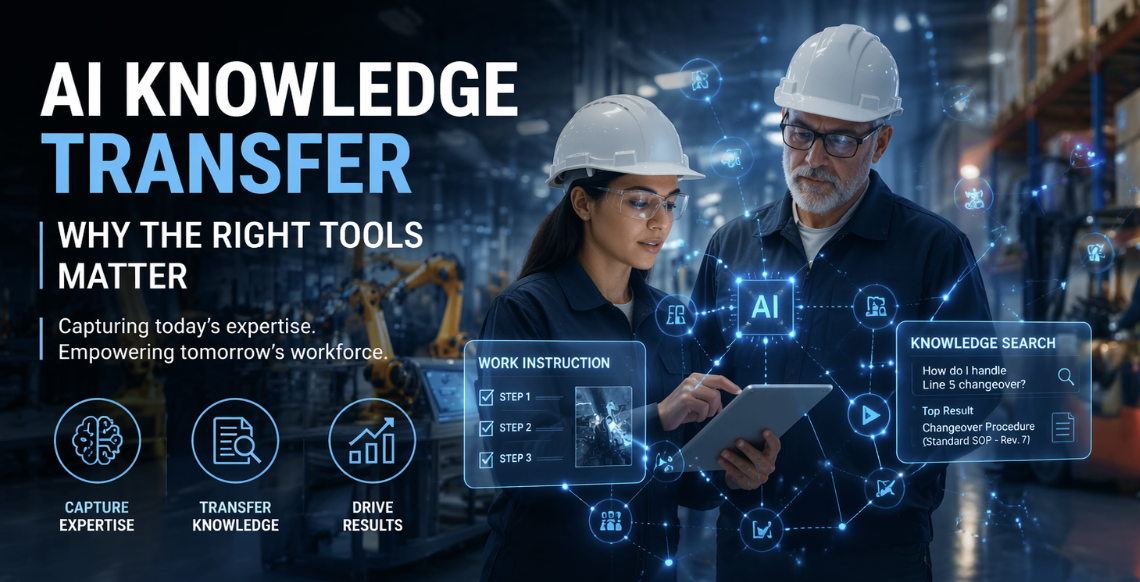
Artificial intelligence is now everywhere in enterprise marketing, but not every AI investment creates operational value. In many cases, AI is treated as a novelty or feature label rather than a system designed to solve a concrete business problem. Epicor’s recent analysis makes a sharper argument: the real opportunity is not simply “using AI,” but using AI knowledge transfer to capture, structure, and transfer critical operational knowledge before it disappears.
For Stratify Holdings, that framing matters. Stratify’s broader mission is rooted in business process optimization, enterprise software enablement, and value creation across manufacturing, distribution, retail, and adjacent service environments. That means the most useful AI is not generic AI. It is operational AI: systems that help organizations preserve expertise, accelerate training, reduce variation, and improve execution across the plant floor, warehouse, and back office.
This is especially relevant for Stratify’s KineticForce and ProphetForce brands. KineticForce serves manufacturers using Epicor Kinetic and emphasizes visibility, automation, and scalable operations. ProphetForce serves distributors using Epicor Prophet 21 and focuses on implementation, optimization, training, and measurable operational improvement. In both cases, the strategic implication is the same: AI knowledge transfer is becoming a competitive capability, not a side feature.
AI Knowledge Transfer Starts with a Real Operational Problem
Epicor’s article is valuable because it avoids abstract AI language and begins with a practical diagnosis. The core problem is not a lack of data alone. It is a lack of knowledge capture and knowledge transfer. Over time, organizations accumulate expertise in the minds of supervisors, operators, planners, buyers, warehouse leaders, and maintenance personnel. When those people retire, leave, or change roles, the company can lose years, or even decades, of embedded know-how.
Epicor describes this as a widening knowledge gap caused by two converging pressures: experienced workers are leaving, while newer employees often need faster ramp-up periods and may turn over before they become fully effective. The consequence is not merely inconvenience. It is lower productivity, more errors, slower onboarding, and weaker operational consistency.
That insight should resonate strongly with both manufacturing and distribution leaders. In a manufacturing setting, tribal knowledge often governs setup nuance, troubleshooting logic, downtime routines, and the difference between nominal output and truly optimized throughput. In a distribution setting, tribal knowledge often lives in order flow exceptions, picking logic, inventory handling, freight coordination, customer-specific process knowledge, and the unwritten rules that keep service levels high. Epicor’s examples make clear that what appears informal can actually be mission-critical.
Knowledge Transfer Is More Valuable Than Generic AI Hype
One of the strongest elements of Epicor’s piece is its critique of hype-driven AI adoption. The article notes that the current market is crowded with AI-labeled products, but many of them solve trivial problems or function more as marketing than operational infrastructure. By contrast, Epicor argues that AI should be evaluated based on whether it solves real business challenges in the “make, move, and sell” economy.
That distinction is essential for a Stratify Holdings audience. Mid-market manufacturers and distributors do not need AI theater. They need outcomes. They need faster onboarding, lower rework, more consistent process execution, better use of ERP data, and more reliable transfer of expertise across teams and sites. The right question is not “Do we have AI?” but “What operational bottleneck does this AI remove?” That is the kind of positioning Stratify can credibly own in content strategy because it aligns with the firm’s value-creation and process-optimization posture.
For SEO and thought leadership purposes, this also gives Stratify a more differentiated angle. Rather than publishing another generic “AI is changing business” article, this blog can frame AI knowledge transfer as a strategic discipline tied directly to labor continuity, execution quality, and ERP-centered operational maturity.
AI Knowledge Transfer and the Real Cost of Lost Expertise
Epicor reinforces its argument through the well-known Vienna Beef example. After the company moved to a new facility, product quality changed in ways leadership could not initially explain. The missing factor turned out to be a small but important process condition tied to a worker named Irving, whose routine movement of sausages allowed them to warm before cooking. Once he retired instead of relocating, that tacit knowledge disappeared, and the company spent roughly a year and a half discovering what had been lost.
The anecdote is memorable because it shows how operational excellence often depends on details that are undocumented, habitual, and easy to overlook. In manufacturing, that might be the sound a machine makes before a fault worsens, the sequence a team follows during changeover, or the exact judgment call that prevents scrap. In distribution, it might be the warehouse supervisor who instinctively knows the fastest pick path during peak volume, or the CSR who understands which workflow exceptions matter most for a critical account. Epicor explicitly points to these kinds of examples.
For Stratify Holdings, this has a direct advisory implication. Clients are often investing in new software, new processes, or new automation with the expectation of improved performance. But technology alone does not protect value if the operating knowledge required to use that technology remains fragmented or locked in people’s heads. True transformation requires both system change and knowledge continuity. That is where the conversation becomes highly relevant for KineticForce and ProphetForce.
Knowledge Transfer in KineticForce Manufacturing Environments
KineticForce presents Epicor Kinetic as a way for manufacturers to unify operations, automate workflows, and gain real-time visibility and scalability. That positioning maps naturally onto the knowledge-transfer problem. If a manufacturer has better system visibility but still relies on undocumented tribal knowledge to run setups, maintenance tasks, quality checks, and production routines, then part of the operational risk remains unresolved.
In practice, this means KineticForce can frame AI knowledge transfer as an extension of manufacturing transformation rather than a separate initiative. For example, when a manufacturer implements new ERP or MES processes, the success of that investment depends on whether frontline users understand the work standard, follow it consistently, and can access instructions in the flow of work. Epicor’s Acadia model emphasizes structured digital work instructions, natural language search, compliance tracking, skills management, quiz generation, and feedback loops. Together, these elements turn knowledge from an informal dependency into an operational asset.
That matters for KineticForce because manufacturers often pursue ERP and plant-system modernization to improve throughput, reduce downtime, strengthen labor productivity, and standardize execution across teams. AI knowledge transfer supports each of those goals. It reduces dependence on a handful of veterans, shortens training cycles, reinforces standard work, and helps ensure capital investments actually deliver the returns anticipated in the business case. Epicor makes this exact point when it argues that preserved knowledge improves onboarding, reduces process variation, and helps new investments perform as intended.
AI Content Marketing
From a content marketing standpoint, KineticForce can use this theme to publish highly specific follow-up pieces such as:
- how AI knowledge transfer reduces training time in discrete manufacturing
- why connected worker AI strengthens standard work adoption
- how manufacturers can protect tribal knowledge during ERP modernization
Those article angles would be commercially stronger than broad AI commentary because they connect directly to the manufacturer’s daily operating reality.
AI Knowledge Transfer in ProphetForce Distribution Operations
The same core idea plays out differently, but just as powerfully, in distribution. ProphetForce emphasizes implementation, upgrade, optimization, training, managed support, and the translation of Epicor Prophet 21 capabilities into measurable value. Its own messaging around the 2025.1 release highlights automation, AI-driven insights, improved workflows, enhanced data management, shipping confirmation integration, and modernized user experience.
What the Epicor article adds is another layer: workflow intelligence is only fully valuable when procedural knowledge is also searchable, structured, and teachable. A distributor may have excellent ERP records and strong transaction processing, but still suffer performance loss when knowledge about exceptions, account handling, warehouse routines, or cross-functional coordination remains tribal. AI knowledge transfer closes that gap by helping people find procedures in natural language, converting SOPs into structured documentation, and reinforcing learning through generated assessments and reporting.
This complements ProphetForce particularly well because Prophet 21 already sits close to mission-critical distribution processes. ProphetForce can therefore position itself not just as an implementation partner, but as a guide for operational enablement. If the ERP is the transactional backbone, then AI-assisted knowledge transfer can become the human execution layer that helps teams adopt processes consistently and profitably. That is a persuasive narrative for distributors dealing with labor turnover, seasonal scaling, customer complexity, and service pressure.
A strong ProphetForce-specific interpretation would be this: AI in distribution should not stop at dashboards and recommendations. It should also help preserve the procedural intelligence that keeps warehouses efficient, customer service consistent, and order execution reliable.
AI Knowledge Transfer Requires More Than Content Storage
A subtle but important part of Epicor’s article is that the solution is not simply document storage. The system described is more dynamic. Existing SOPs and videos become structured digital work instructions; employees can search using natural language; managers can track acknowledgments and comprehension; and frontline users can feed improvement suggestions back into the system.
This matters because many organizations incorrectly assume their shared drive, PDF archive, or binder library already solves the knowledge problem. It does not. Information that is technically available but difficult to find, difficult to interpret, or disconnected from the actual workflow is often operationally invisible. Epicor’s argument is that knowledge becomes useful when it is structured, accessible in context, measurable, and continuously refined.
That is a powerful message for Stratify Holdings to emphasize across brand content. The future is not just digital documentation. It is operationally active documentation, supported by AI and connected to how people actually work.
AI Knowledge Transfer as a Strategic Position for Stratify Holdings
At the parent-brand level, Stratify Holdings is well placed to speak about AI knowledge transfer as a cross-functional business issue rather than merely a software feature. The company’s public positioning includes business process optimization, purpose-built software solutions, and professional and managed services across multiple verticals and operating models.
That means Stratify can own a broader thesis:
AI creates the most value when it protects and scales operational knowledge across the enterprise.
This thesis works because it spans strategy, operations, systems, training, governance, and continuous improvement. It also bridges KineticForce and ProphetForce cleanly. On the manufacturing side, the conversation is about standard work, labor productivity, plant continuity, and return on operational investments. On the distribution side, it is about workflow consistency, service reliability, ramp time, and execution quality. The underlying discipline is the same.
Final Thoughts on AI Knowledge Transfer
The strongest takeaway from Epicor’s article is simple: not all AI is created equal because not all AI solves an expensive business problem. In manufacturing and distribution, one of the most expensive and least visible problems is the loss of institutional knowledge. When expertise disappears faster than it can be transferred, performance drifts, onboarding slows, and improvement efforts stall.
For Stratify Holdings, that insight opens the door to more sophisticated and more useful AI messaging. KineticForce can show manufacturers how AI knowledge transfer strengthens operational consistency and supports transformation around Epicor Kinetic. ProphetForce can show distributors how AI knowledge transfer improves adoption, execution, and long-term value around Epicor Prophet 21. Stratify Holdings, at the portfolio level, can frame both as part of a larger strategy for resilient, scalable, process-driven growth.
Need Help Turning AI Into Operational Value?
Stratify Holdings helps manufacturers and distributors align technology, process, and execution so critical knowledge does not walk out the door. Explore our solutions or connect with our team to discuss how KineticForce and ProphetForce can support your next phase of growth.
